
Remembering Hurricane Helene in Photos
- Sep 19, 2025
- 5 min read
We go all over the world to bring clean water to people who need it. A year ago, we didn’t expect that need would come to our backyard as well, but it did.
Now, as the one year anniversary of Hurricane Helene approaches, we're looking back through our photo archive as a way to pause and remember all we've experienced--the good and the devastating alike.
To accompany the images, and to remind us of the human impact, we asked several of our team members to describe their personal experiences of the flooding.

“September 27th was the start of a two-month long adrenaline rush. There was no time to breathe, and no place to escape for a breather anyway. The disaster was all-encompassing – impacting every aspect of our lives and our environment.” Claire Dresselhaus, WTW Disaster Response Manager

“That morning we woke up and there was no power. We were like, ‘Okay, we’re mountain people, we can live without power. Our water’s on well — it’s okay though, we can fill some tanks up in the meantime. It’ll probably be a day, maybe. I bet by noon, lunch time, we’ll have power again.’ All of a sudden I hear my daughter upstairs scream. And she’s like, ‘Mommy, the water is rising and rushing up to the house!’ And we’re just staring outside. What was once a road, is now a roaring river.” Courtney Mattar, Sr. Director of Development and Partnerships

“I remember sitting in my living room and looking out the window and watching the trees and thinking, ‘That’s really bizarre. That’s more than just wind.’ The trees would just twist completely around, then lay over almost ninety degrees and plop back up. And then you would start hearing trees pop from falling.” LaRaye Rudicile, WNC Program Manager (Zone 1)

“Water was coming in downstairs and I couldn’t figure out where it was coming from. The best we could figure, it was coming in somehow through the chimney.” LaRaye Rudicile

“[Days later] we were in a community right outside of Burnsville, along the Cane river. But standing along the banks it just felt like I was not in the United States. I had this overwhelming, almost visceral feeling that I had been to this place before, but it’s not here. This isn’t home.” Courtney Mattar

“As each day passed, Friday, Saturday, Sunday, Monday with no water in a city of almost 100,000 people, the desperation grew — no water to drink, no formula for babies, the disabled and elderly stranded in apartment complexes, families without water to flush toilets." Tina Owen, VP of Global Partnerships, WTW

“Around lunch time, maybe one o’clock, the rain stopped. The sun came out and the skies were blue. And it was silent. Where we live is kind of silent, but it was eerily silent.” Courtney Mattar

“Looking at all of the downed trees and the mudslides that we saw around our houses… all I could think of was, ‘What happened everywhere else?’” Courtney Mattar

“My husband was in Morganton and what should have taken a 45-minute drive to get home took eight hours. He put a chainsaw in the back of his car and literally chainsawed his way up the mountain with a convoy of cars behind him. Two of them had chainsaws, and they cut paths in the road. Two of them would cut trees, and the people behind them were dragging the trees away, just trying to get up the mountain.” LaRaye Rudicile

"Family, friends, neighbors, strangers — people came with open hands and hearts. From the baptists to the anarchists and breweries, everyone said, 'Yes, I can help.'" Tina Owen

“It was very overwhelming. It was—you felt very helpless. And at the same time, for me, I was thinking, ‘Okay, what do I need to do?'” LaRaye Rudicile

“In all of this that I saw I gained a new appreciation for who and what we have that make this life so beautiful, even when we feel we are barely staying afloat in the rising waters.” Claire Dresselhaus

“I pulled up [to the Boone warehouse] and I see Doc, and I see Mandy, and I see Cory, and all of these other familiar faces. All of the other people who work here in the Boone office. No one knew what to do. We didn’t communicate, but we all showed up. And so we just looked at each other, gave lots of hugs, tried to swallow our tears, and said, ‘Let’s get to work.’" Courtney Mattar
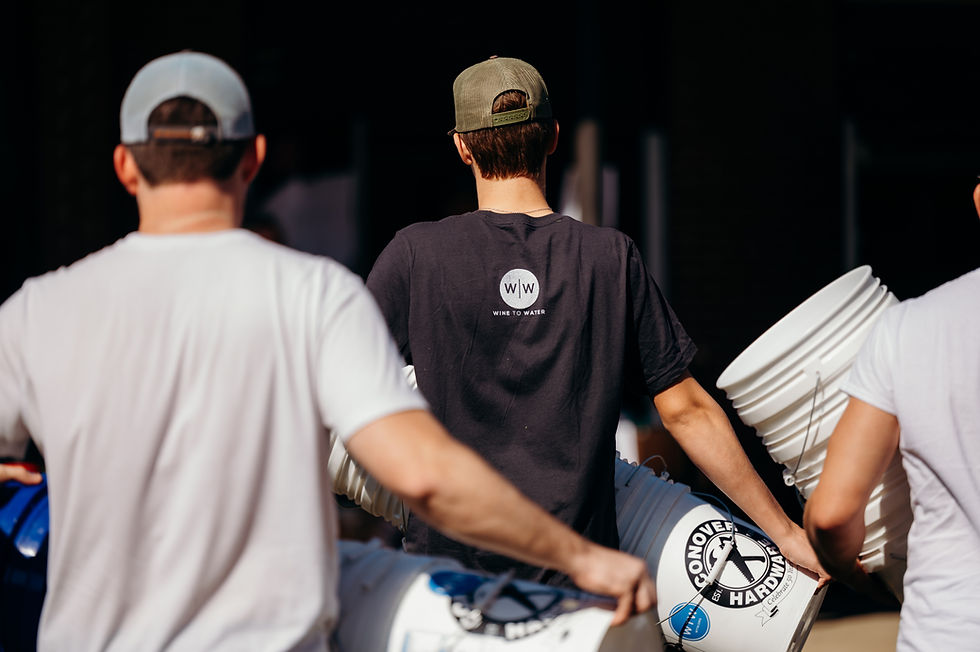
“Days consisted of obsessively checking for updated NTU levels (or Nephelometric Turbidity units – a term all of Asheville became well-acquainted with) in the North Fork Reservoir, flushing toilets with water from dehumidifiers or leftover dish-washing, and skipping coffee because that was water that we didn’t really need, all before heading to work at WTW’s water station in Asheville where we filled reusable water receptacles all day every day, listening to story after story of people’s experiences of the storm.” Claire Dresselhaus

“People would come to line up; they would wait for hours to get water. They’d come every day to walk home just so they could have some clean water to drink and maybe make a meal with.” Courtney Mattar

“What I saw in the people around me last fall was creativity to find ways to cope with an unprecedented disaster, like when an apprentice welder saw us holding our makeshift four faucet manifold from the tanker truck on our shoulders and ran off to weld a perfect fitting stand to relieve us of that unpleasant duty. I saw vulnerability to ask for and receive help and perseverance to figure out what role we could play in helping in our own unique ways. I saw empathy to check in on our neighbors who have always been there, but we thought we were too busy for until we realized how interconnected and dependent on each other we really are.” Claire Dresselhaus

“Water is so destructive and uncontrollable. We know it finds a way, its own path. Yet it also provides exactly what we need. We need it to survive, we need it to grow our food, we need it to stay hygienic and clean. And so in this storm it was the very thing that got us to the devastation and destruction and loss of life and catastrophe. But once the waters receded, it was also the very thing that everybody needed and couldn’t get.” Courtney Mattar

“There’s not a word to describe the tragedy that people experienced, and the devastation - the mass devastation - that still you see driving every day." Courtney Mattar

"We're not done. Our people still need us to rebuild, and there is much to do; it will be years before our communities and our land truly recover. But what I learned is our healing started right here in the line for water. This is the beauty of our hurricane story — our people, our neighbors, strangers coming together to help one another in a time of great need." Tina Owen
“I don’t think any of us will ever be the same again.” LaRaye Rudicile
To everyone who has helped rebuild Western North Carolina, we thank you. If you live in Western North Carolina and would like your water quality tested, please reach out.